
Jean-Philippe Arroyo was a speaker at the 5th T.R.A.D.E. AIJA Commission Annual Conference “Vertical power – About the new VBER and beyond!” organized by AIJA, which was held in Bologna, on the theme “Balancing power in B2B relationships”.
Month: June 2022
Controlling employer monitoring smart working : a CNIL priority in 2022
The CNIL has included smart working surveillance in its priority control themes for 2022, along with commercial prospecting and the cloud. The priority themes represent one third of the controls carried out by the CNIL each year. Indeed, the tools for monitoring the work of smart workers have developed and the CNIL found it necessary to check the compliance of employers’ practices with the General Data Protection Regulation (GDPR).
Smart working is only a way of organizing work, and the employer has the power to supervise and control the performance of the tasks entrusted to the employee. But this new digital terrain and these new work tools necessarily impose new rules on the employer.
The devices implemented by the employer must remain proportionate to the objective pursued and must not infringe the employee’s rights and freedoms, for example his right to privacy. The employer must inform the employees and consult the staff representatives for transparency of the surveillance systems within the framework of a social dialogue. The Labour jurisdictions prohibit permanent surveillance, except in exceptional cases due to the specificity of the task performed by the employee. The CNIL therefore advises employers to give priority to monitoring the tasks performed rather than the working time, and to ask employees for regular reports in order to move away from constant surveillance.
The CNIL also reminds that if the employee uses personal tools for smart working, the level of security and confidentiality of personal data must be the same regardless of the equipment used. This can nevertheless make it difficult for the employer to access professional data, hence the need for the employer to properly frame the use of personal tools. Finally, regarding videoconferencing, the employer can only force an employee to activate his camera in certain specific situations such as an HR interview or a meeting with clients. To promote the protection of personal data, the CNIL encourages the use of tools allowing the blurring of the background when the camera is activated.
The CNIL will therefore carry out numerous controls on smart working this year, which may be carried out remotely, on site, on hearing, on documents in case of complaint from an employee or on its own initiative. The CNIL has the possibility to give formal notice to the controlled company to comply with the GDPR within a period of 6 to 12 months, to sanction financially or to withdraw certifications, reminders or injunctions under penalty payment. Finally, the CNIL may decide to make its decisions and sanctions public.
It is therefore necessary to be vigilant in the implementation of tools to control the work of the smart worker, and it is recommended to pay particular attention to the drafting of the texts framing smart working in this respect.
Cancellation of the employment contract during a corporate mandate: employment contract suspended or resignation?
An employee hired by a company in 1970 became its Chief Executive Officer in 1990. He signed the minutes of the Board of Directors appointing him as a corporate officer, stating that he was “waiving the benefit of his employment contract and no longer being remunerated under it“. In 2014, he was revoked from his position as Chief Executive Officer, and the company deduced that he had resigned from the employment contract when the minutes were signed in 1990 and that he no longer had any link with the company. However, the employee maintained that this signature only suspended his employment contract and that at the end of his mandate, he became an employee of the company again. As such, he applied to the Labour courts to obtain judicial termination of his employment contract to the detriment of the employer.
The question is to know whether the mention in the minutes manifested a clear, serious and unequivocal will of the employee to terminate his employment contract, pursuant to the case law rendered under article L1237-1 of the French Labour Code, or whether it only resulted from the non-cumulation of the functions of corporate mandate and the functions of employee.
In a decision dated March 18, 2022 (Cass. soc. n°20-15.113), the Social Chamber of the French “Cour de Cassation” recalled that the employment contract of an employee invested with a corporate mandate exclusive of any subordination link is, in the absence of any contrary agreement, suspended during the time the mandate is exercised. On the other hand, if the person concerned is in a situation of legal subordination to the company, if his or her duties as an employee are clearly different from those as a corporate officer and if a separate remuneration is paid under the employment contract, the employee may combine a corporate mandate with an employment contract. This was not the case in this instance, as the principle was that the employment contract was suspended during the term of office. However, as the employee had declared that he was giving up his employment contract, had he thereby cancelled the suspension and resigned?
For the “Cour de Cassation”, the wording in the minutes is equivocal in that it can be considered as the sole application of the principle of non-cumulation of the corporate mandate and employee. Thus, it does not imply a waiver of the principle of suspension of the employment contract.
The position of the “Cour de Cassation” may seem questionable in view of the wording of the minutes, and calls for caution in order to ensure that the situation legally corresponds to the will of the parties.
“Macron Scale”: The French Cour de Cassation has (finally) decided!
The saga of the “Macron scale” seems to have been brought to an end by the two long-awaited decisions of the Social Chamber of the Cour de Cassation ruling in plenary session. The decisions rendered on May 11, 2022 (Cass. soc. May 11, 2022, n°21-14.490 and 21-15.247) confirm the legitimacy of this compensation scale for unfair dismissals.
The litigation related to the validity of the “Macron scale” was as follows: several French Labour Courts and “Cours d’Appel” refused to apply this legal compensation scale, which they considered to be contrary to article 10 of ILO Convention 158 and article 24 of the European Social Charter, which establishes the principle of “adequate” reparation of the damage suffered by an employee who has been dismissed without real and serious cause (see our Newsletters of September 2021, January 2020, June and February 2019 on this issue).
As a reminder, the “Macron scale” resulting from Article L 1235-3 of the French Labour Code introduced by the “Macron” ordinances of September 22, 2017, sets minimum and maximum amounts, expressed in months of gross salary, of compensation awarded to employees dismissed without real and serious cause, depending on the size of the company and their seniority.
This scale was challenged because of its very nature, which, according to some, necessarily prevents full compensation for the damage. The adequate indemnity was understood by the latter as an indemnity to be calculated in concreto according to the damage suffered as a result of the unfair dismissal.
It should be noted that the scale was determined on the basis of an average evaluation of damages awarded before 2017 by the “Cours d’Appel”. Moreover, as the scale is made up of a minimum and maximum amount for each year of seniority, the judge still has the possibility of adapting, within a predefined range, the amount of the compensation to make it adequate to the employee’s damage.
Opponents of the scale feared that it would make it easier for employers to consider dismissing an employee by knowing in advance what compensation they would have to pay. The “Cour de Cassation” ruled on these different points, setting out its arguments in detail. The pattern is relatively the same in both judgments, except that in one case the employee relies on article 10 of the ILO Convention 158 to counter the scale and in the other case he relies on article 24 of the European Social Charter.
First, the High Court recalled that article 24 of the European Social Charter has no direct effect in domestic law in a dispute between individuals. Thus, the invocation of this article could not lead to the exclusion of the application of the provisions of article L 1235-3 of the French Labour Code. On the other hand, article 10 of ILO Convention 158 has direct effect.
These texts were invoked to remind the Court that the compensation must be adequate to the damage suffered by the employee. The Court specifies that the term “adequate” referred to in these articles means that the compensation for unfair dismissal must, on the one hand, be sufficiently dissuasive to avoid unjustified dismissal, and on the other hand, be reasonable to allow compensation for the unjustified loss of employment. The High Court assures that in this respect, the indemnity provided for by the “Macron scale” is adequate. To this end, it invokes two arguments: on the one hand, the exceptional situations in which the scale is set aside to allow for an even more adequate compensation, i.e. in cases of nullity of the dismissal; on the other hand, the dissuasive nature of the sums provided for by the judges’ ex officio application of the provisions of Article L 1235-4 of the Labour Code, which provides in certain cases for the reimbursement by the employer to the administration of the unemployment benefits paid to the dismissed employee, from the day of his dismissal to the day of the judgment, up to a limit of six months.
Thus, the role of the judge in this type of dispute is not to judge whether the compensation should be decided in concreto or on the basis of the scale, but to set the amount of this compensation, if any, within the range provided for in relation to the employee’s seniority. Thus, the “Macron scale” cannot be set aside except in case of nullity of the dismissal: the “Cour de Cassation” has finally decided after several years of legal uncertainty.
However, this does not take into account the report of the European Committee of Social Rights (ECSR), which monitors Member states’ compliance with the European Social Charter, which has just considered the “Macron scale” to be contrary to France’s international commitments, just as it had sanctioned similar legislation in Finland and Italy. This report, which is not expected to be made public until September, does not have any binding effect on French judges, but it could continue to fuel litigation in the courts.
Status of platform workers, overview of the case law
The majority of platform workers are self-employed entrepreneurs who use one or more electronic platforms to carry out their professional activities. These include Uber drivers and Deliveroo delivery drivers, to name just two of the best-known platforms, but this business model is booming.
The French Labour Code attaches a presumption of non-salaried status to workers with a self-employed status.
Indeed, according to article L 8221-6 of the French Labour Code, natural persons registered in the various professional registers and directories are deemed to be non-salaried. However, this presumption can be reversed, leading to a reclassification of these self-employed workers as employees. This change of status is not trivial, and entails the application of all the rules of Labour law (paid vacations, right to strike, freedom of association, medical examination, minimum wage, regulated termination of the contract, taxes and social contributions on salaries, overtime or employer’s liability…). All these upheavals, which are in the interest of the worker and frighten digital platforms, depend on the existence of a subordination link between the platform and the workers. It is this link that case-law is trying to define more and more precisely, not without difficulty, through decisions of social and criminal courts.
In five key decisions, French judges have outlined the clues that could lead to the reclassification of the status of platform workers as employees. This analysis allows employers to understand where the limits are not to be crossed concerning the directives, the control of the execution and the sanctions for the non-execution of the missions of platform workers.
On March 4, 2020, the Labour Chamber of the French “Cour de Cassation” recognized the existence of a subordination link in the “UBER case” (Cass. Soc. March 4, 2020, n°19-13.316). Indeed, the power of direction was characterized by the impossibility for the driver to choose his customers and by the incentive to remain constantly connected on the application subject to loss of access to the account in case of too frequent disconnection. The power of control was characterized by the algorithms predicting the route and tracking by geolocation. Moreover, in case of inefficiency, the driver sees the price of his trips reduced. Finally, the power of sanction was illustrated in the loss of access to the application for reasons “at the discretion of the UBER platform“.
In line with this decision, on June 24, 2020, the “Cour de Cassation” again characterized a subordination link in the “Take Eat Easy case” (Cass. soc. June 24, 2020 n°18-26.088). This judgment states that geolocation is a tool for monitoring the performance of workers. Moreover, the penalties implemented by the platform such as loss of bonus, summons or loss of access to the account are evidence of the characterization of a sanctioning power.
Judges do not automatically reclassify self-employed workers as employees and try to analyze each situation. Thus, on April 5, 2022, the “ClickWalker case” (Cass. Crim. April 5, 2022 n°20-81.775) reminded us in which case the subordination link cannot be characterized. On this platform, the workers can abandon their mission during its performance. The company has no means of control during the performance of a mission, it only checks the result in order to release the compensation in case of success, which, for the High Court, is the very principle of any commercial contract.
Similarly, on April 13, 2022, the Labour Chamber, in the “LE CAB case” (Cass. soc. April 13, 2022 n°20.14-870) recalled that the cluster of evidence ensuring an insertion of the worker in an organized service is not sufficient to demonstrate the existence of a subordination link. Here the Court states that geolocation and the evaluation of services are two things inherent to the services of platforms and therefore cannot constitute a power of control or sanction. This decision allows to redefine the level of control and sanctions that platforms can reach without risking to enter into the framework of subordination.
In opposition to these last two decisions of the Labour Chamber, the Criminal Court, on April 19, 2022, sanctioned the Deliveroo platform with the maximum penalty for concealed work, i.e. 375,000 euros for abuse of the workers’ self-employed status. This sanction was motivated by a set of indicators. In particular, it was emphasized that it was the platform that created the service offer and not the delivery person, and that there was a real operational framework in the form of a special outfit and invoicing elements provided by the company. Moreover, these workers are in a situation of economic dependence and do not have the means to work for other market players. Not to mention the problem of geolocation, which is synonymous with control by the platform. The Deliveroo company has appealed and denies the existence of any link of subordination between the platform and the independent workers. This decision is important, especially since the Court followed the opinion of the Labour Chamber of the “Cour de Cassation”, which it had consulted beforehand. The opinion was therefore shared by this social court, making the jurisprudential landscape even more fluctuating.
In the absence of a homogeneous definition of the status of platform workers by the courts, the legislator has been able to get around the problem of requalification by directly supervising platform workers and by ensuring that the latter, even if they do not qualify as employees, can have access to social dialogue. Thus, we can underline the creation, on April 21, 2021, of an Authority of Social Relations of Employment Platforms (ARPE) in charge of regulating the social dialogue between the platforms and the workers who are linked to them by a commercial contract. The ARPE organizes elections and training for platform workers’ representatives and protects them in the event of breach of contract. The goal is to negotiate with the platforms their right to better working conditions in the near future.
Occupational health law, any new obligations for the employer?
Applicable since March 31, 2022, French law n°2021-1018 of August 2, 2021, supplemented by questions and answers from the Ministry of Labour, Full Employment and Integration, strengthens the prevention of occupational risks and medical monitoring of employees while extending the definition of sexual harassment, in the Labour Code, to several behaviors with sexist or sexual connotations coming from a person or a group, concerted or not.
The employer must therefore update the internal regulations, which must include updated provisions on moral/sexual harassment and sexist behaviour. The employer must also ensure that it meets its safety obligation and continue to take the necessary measures to protect the physical and mental health of its employees.
With regard to risk prevention, the employer is required to assess the risks to which the worker is exposed as a result of the organization of his or her work, in association with the CSE, the occupational health referents and the occupational health and prevention services. In this line, French law requires to facilitate the traceability of the single document of evaluation of professional risks (DUERP). The successive versions of the DUERP will now have to be kept for 40 years on a dematerialized portal and the list of people who can access it will be extended. It should be noted that the CSE must now be consulted on the DUERP and its updates. According to the DUERP’s contributions, in a company with more than 50 employees, the employer will have to plan an annual risk prevention program adapted to the risks highlighted by this document.
The third subject addressed by this law is the medical follow-up of employees. By adapting existing medical check-ups and creating new ones, the idea is to allow for a smooth reintegration of the employee into his or her job or into a new position. Some preventive visits will make it possible to fight against the risks of disinsertion and to ensure that each employee is in his or her place in the company, that he or she is not overworked or overexposed to risks. It is with this in mind that the law creates a mid-career check-up, which is set out in article L 4624-2-2 of the French Labour Code. The employer will have to organize, at the initiative of the Occupational Health and Prevention Service (SPST), the employee or himself, a medical check-up for each employee reaching the age of 45 (or at another deadline set by branch agreement) or at the same time as any other medical check-up scheduled within 2 years before this deadline. During this visit, the occupational physician must verify the suitability of the employee’s position and state of health, taking into account exposure to risks. He or she will raise awareness of the challenges of aging and, following this visit, may request that the employee’s workstation or working hours be adjusted if necessary. The second new feature as of March 31, 2022 is the liaison visit, defined in article L 1226-1-3 of the French Labour Code. After a sick leave of at least 30 continuous or discontinuous days, the employee will be able to meet with his or her employer, remotely or in person, in connection with the SPST. This liaison meeting, organized at the request of the employee or the employer, will make it possible to consider the return to work under the best conditions to fight against the loss of employment, while informing the employee of his rights. It should be noted that the employer must inform the employee that he/she can request this service. Finally, a post-exposure visit, defined in article L 4624-2-1 of the French Labour Code, is provided for as soon as an employee who was specifically exposed to a risk stops being exposed to this risk before the end of his career. The employer must inform the Occupational Health and Safety Service of the cessation of exposure to a health risk justifying in-depth monitoring of the employee’s departure or retirement. The visit, if the SPST considers it necessary, is carried out with the occupational physician who analyzes the exposure to risks and gives the employee a report, which the physician will also place in the employee’s medical file for better follow-up. Post-exposure surveillance may also be set up if necessary.
The law on health at work also modifies the visits already in place within the company, making the pre-resumption visit earlier and the resumption visit reserved for the most risky cases. Indeed, the pre-resumption visit, referred to in article L 4624-2-4 of the French Labour Code, reserved for employees who have been off work for more than 3 months, becomes possible for all employees who have been off work for more than 30 continuous or discontinuous days. This pre-resumption visit may lead to a modification of the workstation. The resumption visit, referred to in article L 4624-2-3 of the French Labour Code, is now reserved for long sick leave, at least for non-work-related sick leave, and has been extended from more than 30 days to at least 60 days. The 30-day minimum remains unchanged for sick leaves due to an occupational disease or an accident at work.
The rules applicable to the information and prevention medical visit and to periodic medical visits have not changed.
In addition, the supervised trial, which already existed, is now regulated: this system, managed by the health insurance system, allows employees to request a test of their ability to return to their former position or to a new position. The supervised trial is subject to the opinion of the occupational physician, who judges if the procedure is useful.
Lastly, the Convention de Rééducation Professionnelle en Entreprise (CRPE), initially reserved for disabled workers, will be accessible, as of March 31, 2022, to disabled workers and to all employees declared unfit or at risk of being unfit.
Through this essential text, the employer certainly has new obligations, but the law on health at work will offer him a framed and organized help. Thus, we can underline the change of name of the occupational health services into “prevention and occupational health services” (SPST) supporting the preventive role of the organization and allowing a clear understanding of the objectives. The aim is to offer transparency of the tools for protecting the health of employees in the company.
IDI Annual Conference – Madrid – 10-11 June 2022
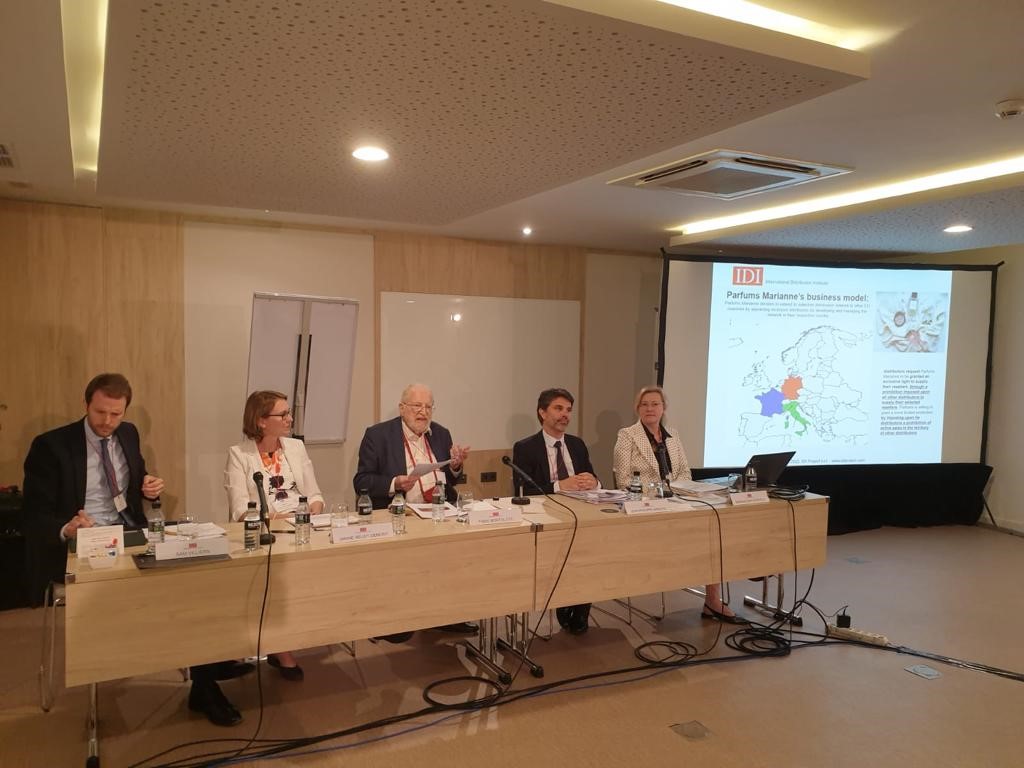
Jean-Philippe Arroyo was a speaker at the IDI annual conference, dedicated to the new EU rules on vertical restraints (Block Exemption Regulation 2022/720 of May 10, 2022), which was held in Madrid, on the theme “Establishing a selective distribution network managed through exclusive distributors in different EU countries”.
The whistleblower: the impact of the Waserman law on criminal provisions (4/4)
The Waserman Act of 21 March 2022, which transposes a European directive of 23 October 2019 and aims to improve the protection of whistleblowers in France, comes into force from 1er September 2022. For more information, we refer you to our three previous news posts on this topic.
This fourth and final post is about to the analysis of the consequences of this law in terms of criminal law and procedure, and in particular:
- The criminalization of reprisals from the point of view of discrimination: a new kind of discrimination has been introduced at the article 225-1 of the French Criminal Code. Discrimination based on the status of whistleblower, facilitator, or any person in connection with a whistleblower, whether a natural or legal person, is now punishable of 3 years imprisonment and a fine of €45,000.
- Increased repression against those who attack the whistleblower: the amount of the fine for dilatory or abusive proceedings against a whistleblower, known as the “gagging procedure“, has been increased to €60,000 (compared to €30,000 previously).
In addition, the penalty of posting or disseminating the criminal decision complete the main penalty, which has not been increased, of one year’s imprisonment and a fine of €15,000 for obstructing the transmission of an alert.
Furthermore, when criminal proceedings are initiated against a whistleblower with the aim of hindering his or her reporting, the whistleblower may now ask the criminal court to award him or her, at the expense of the civil party, an advance to cover the costs of the proceedings in order to ensure his or her defense, or to cover his or her subsistence. The judge may order investigative measures before making a decision on the matter. In any event, the judge may decide that the advance granted to the whistleblower is final, even if the whistleblower were to lose the case.
- The justifying fact of the whistleblower is reinforced:
- The Sapin 2 law already provided for the criminal irresponsibility of the whistleblower for the disclosure of a secret protected by law in Article 122-9 of the Penal Code. The Waserman Act extends this non-accountability to cases where, in order to support his or her report, the whistleblower “withdraws, misappropriates or conceals documents or any other medium containing information of which he or she has lawful knowledge and which he or she reports or discloses under the conditions defined by the law“. The lack of criminal responsibility therefore applies to the author of the alert who has committed offences of theft, breach of trust or concealment, not in order to gain knowledge of the information but to be able to disclose it. It should be noted that the reform extends criminal liability to persons in the whistleblower’s entourage: accomplices, facilitators, natural persons linked to the whistleblower and legal entities controlled by the whistleblower. As these provisions are more favourable, they will be able to act retroactively (Cass. crim., 17 October 2018, n°17-80.485).
- The establishment of civil irresponsibility in the event of an alert in good faith. Thus, from now on, persons acting in good faith at the origin of the alert will be exempted from the obligation to pay compensation, i.e. those who have “reasonable grounds to believe, when they proceeded to do so, that the alert or the public disclosure of the entirety of this information was necessary to safeguard the interests in question“. The whistleblower will therefore not be required to compensate for the harmful consequences of the disclosure, such as the moral or financial prejudice suffered by the natural or legal person targeted by the alert.
These innovations introduced by the European directive have the effect, on one hand of providing greater protection for whistleblowers and, on the other, of avoiding their isolation.